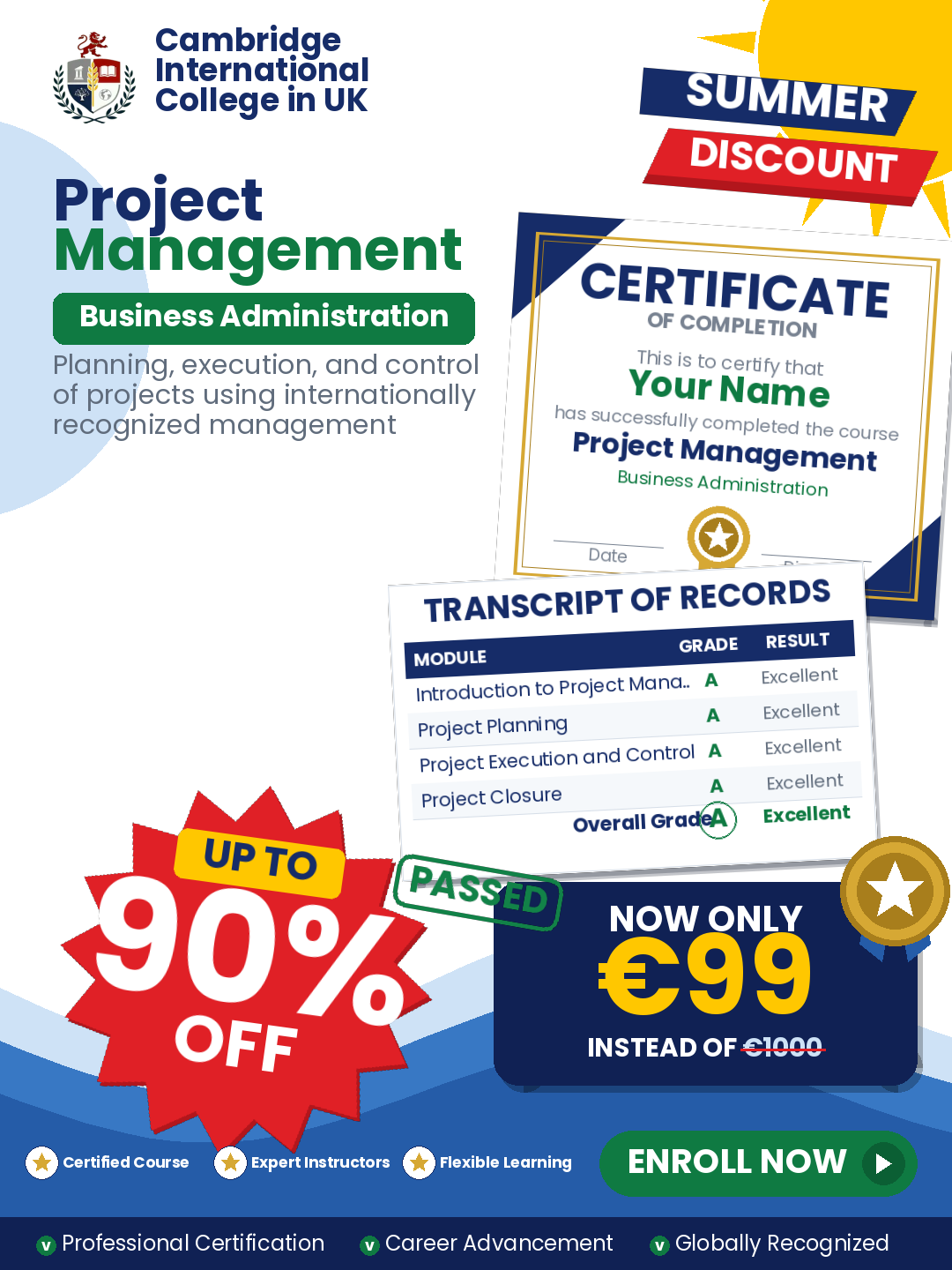
Project Management
Planning, execution, and control of projects using internationally recognized management practices.
A closer look at your course
About the Project Management Course
The Project Management course offered by Cambridge International College is designed to equip students with essential skills in planning, executing, and controlling projects effectively. This program adheres to internationally recognized management practices, ensuring that graduates are well-prepared to meet the demands of the modern business environment.
Course Overview
This course spans a flexible duration of 3 to 6 months, allowing students to tailor their learning experience according to their personal and professional commitments. Delivered through a blended learning approach, students will benefit from both online resources and face-to-face interactions, fostering a comprehensive understanding of project management principles.
Key Learning Objectives
Throughout the course, students will:
- Understand the fundamental concepts of project management.
- Learn to develop project plans that align with organizational goals.
- Gain skills in risk management and mitigation strategies.
- Master the art of effective communication and stakeholder engagement.
- Explore tools and techniques for monitoring and controlling project progress.
Career Opportunities
Graduates of the Project Management course can pursue a variety of career paths in diverse industries. Potential roles include:
- Project Manager
- Program Coordinator
- Operations Manager
- Business Analyst
- Consultant
These positions often require strong leadership and organizational skills, making this course an excellent stepping stone for those looking to advance their careers.
Skills Developed
Enrolling in this course will help you develop a range of valuable skills, including:
- Critical thinking and problem-solving abilities.
- Effective communication and interpersonal skills.
- Time management and prioritization techniques.
- Analytical skills for assessing project performance.
- Leadership and team management capabilities.
These competencies are essential for successfully managing projects and leading teams in any organization.
Course Delivery and Structure
The blended learning format combines the flexibility of online learning with the benefits of in-person instruction. Students will have access to a variety of learning materials, including:
- Interactive online modules.
- Live webinars and discussion forums.
- Case studies and real-world project scenarios.
- Networking opportunities with industry professionals.
This structure allows for a dynamic and engaging learning experience that accommodates different learning styles.
Conclusion
By completing the Project Management course at Cambridge International College, you will be well-equipped to take on challenging roles in project management across various sectors. With a focus on practical skills and real-world applications, this program prepares you to excel in your career and contribute effectively to your organization.
For more information or to enroll in the course, please visit our website or contact our admissions team.
What you’ll learn
Learning objectives drawn from the published course content.
- Distinguish a project from ongoing operations.
- Connect a deliverable to its intended benefit without conflating them.
- Record a bounded charter with actual decision rights.
- Separate stakeholder influence from affectedness.
- Design consultation that can change a requirement.
- Distinguish acknowledgement from agreement or approval.
Show all 36 learning objectives
- Define deliverables and exclusions precisely.
- Break work into owned packages without double counting.
- Link acceptance evidence to the agreed requirements.
- Build a finish-to-start activity network.
- Calculate an earliest completion under stated assumptions.
- Distinguish logical parallelism from confirmed resource availability.
- Detect resource conflicts in an otherwise valid network.
- Distinguish effort, duration and calendar availability.
- Compare conditional responses without inventing extra people.
- Calculate a transparent cost estimate.
- Distinguish baseline, reserve and funding headroom.
- State assumptions and decision rights before committing expenditure.
- Write a specific risk statement with a consequence.
- Assign a response owner and trigger.
- Distinguish an uncertain event from an issue already supported by evidence.
- Compare offers on an equivalent scope.
- Distinguish order, receipt, inspection and acceptance.
- Record a quality exception without inventing its cause.
- Record a change request separately from approved scope.
- Trace impacts across requirements, schedule, cost and risk.
- Preserve a clear authorisation and version history.
- Separate assembly, acceptance and overall progress.
- Calculate a simple completion-cost forecast.
- Connect a deviation to an owned decision and evidence gap.
- Distinguish delivery from accepted completion.
- Assign unresolved items and ongoing ownership.
- Preserve useful learning without claiming unmeasured benefits.
- Integrate scope, schedule, resources, cost and acceptance.
- Defend different model assumptions and status records.
- Use a transparent practice rubric to revise an accountable recommendation.
Inside the curriculum
Explore the published modules and lessons. Full lesson content is available through your student account, with free enrolment. Learning sequence and administrative access controls still apply.
01Purpose,Stakeholders and Verifiable Scope3 lessons
Distinguish a project from ongoing operations. Separate stakeholder influence from affectedness. Define deliverables and exclusions precisely.
- Framing a Temporary Project and Its Authority
- Finding Affected Stakeholders and the Decisions They Need
- Turning Scope Into Verifiable Work and Acceptance
02Dependencies,Resource Feasibility and Budget3 lessons
Build a finish-to-start activity network. Detect resource conflicts in an otherwise valid network. Calculate a transparent cost estimate.
- Calculating Dependencies With Explicit Time Assumptions
- Checking Whether a Logical Schedule Can Actually Be Staffed
- Building a Scoped Budget and a Governed Reserve
03Risk,Quality and Controlled Change3 lessons
Write a specific risk statement with a consequence. Compare offers on an equivalent scope. Record a change request separately from approved scope.
- Managing an Uncertain Event and Responding When It Becomes an Issue
- Comparing Supplier Offers and Verifying What Was Received
- Evaluating a Change Without Rewriting the Baseline First
04Monitoring,Conditional Closure and Project Defence3 lessons
Separate assembly, acceptance and overall progress. Distinguish delivery from accepted completion. Integrate scope, schedule, resources, cost and acceptance.
- Reporting Accepted Output and Forecast Cost Without a False Progress Score
- Closing With Acceptance Evidence and an Honest Handover
- Capstone: Defending a Coherent Project Decision Portfolio
Is this course for you?
Who this is for
Project coordinators,team leads and aspiring managers connecting scope,dependencies,resources,cost,quality and accountable decisions.
Before you begin
Professional reading,basic arithmetic and percentages;complete fictional case and models supplied,no real procurement or personal data required.
Who this is not for
Not PMP or other external accreditation,legal procurement advice,financial advice or authority to approve real spending or operational safety.
Assessment & completion
20 scenario questions, 5 marks each (100 total), covering every lesson. Complete required lessons and select every correct answer before submission. Portfolio/capstone activities support self or instructor review; the portal does not collect or automatically grade projects and they are not an additional certificate gate. Credit allocation awaits institutional approval.
Materials & resources
4 modules with 12 complete lessons, reviewed sources, a connected fictional case, practice portfolio, scored capstone rubric and reusable template.
Your questions, answered
Is prior experience in project management required?
No, this course is designed for beginners, and prior experience is not necessary.
What materials will I need for this course?
You will need a computer with internet access and basic office software.
How is the course delivered?
The course is delivered through a blend of online lectures and interactive sessions.
Will I receive a certificate after completing the course?
Yes, a certificate of completion will be awarded upon successfully passing all assessments.
Cancellation policy
Students may cancel their enrollment up to two weeks before the course starts for a full refund. No refunds will be issued after this period.
Course inquiry
Send a message about Project Management. Our team will reply by email or phone.