Artificial Intelligence for Teachers
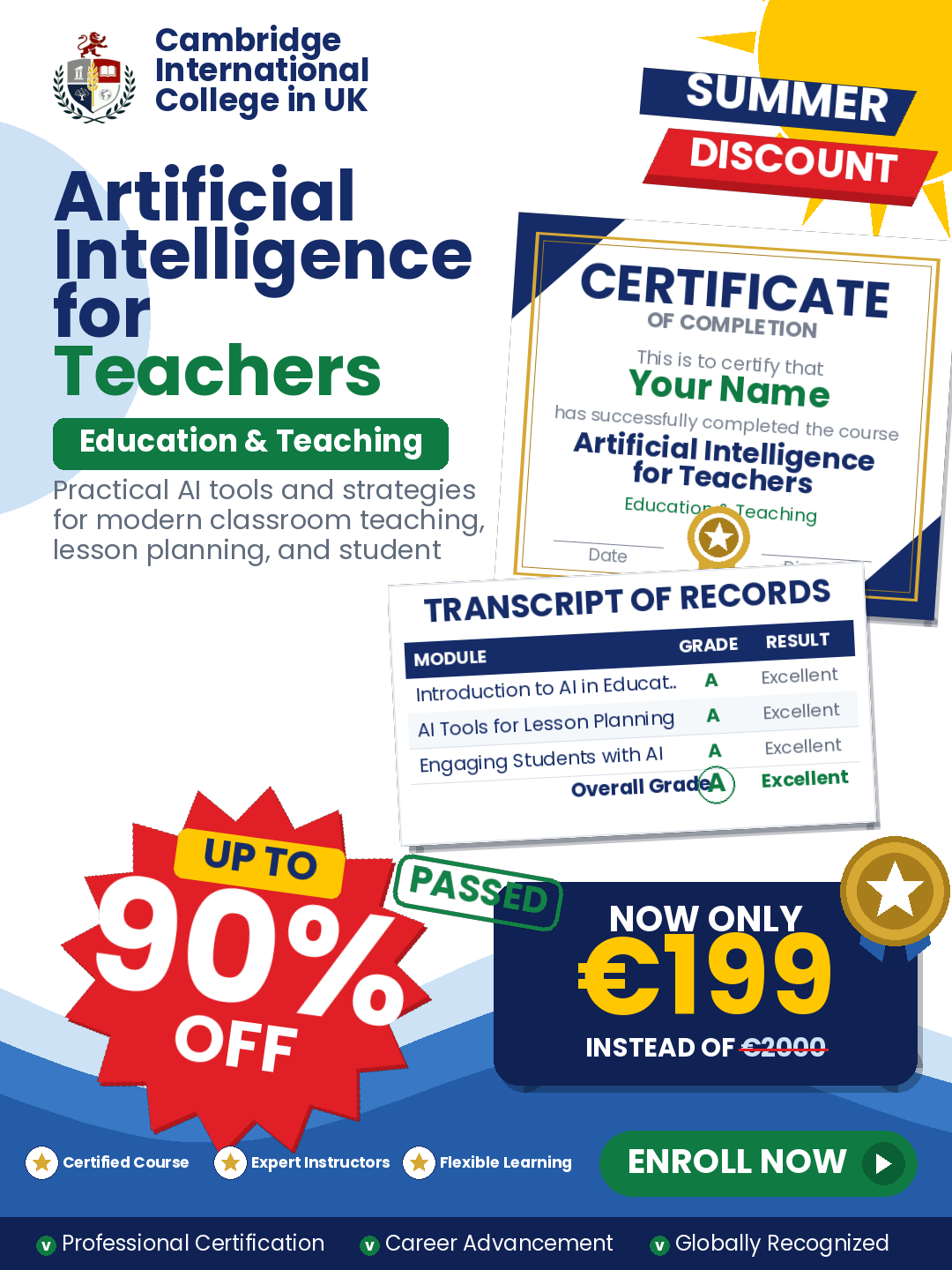
Practical AI tools and strategies for modern classroom teaching, lesson planning, and student engagement.
A closer look at your course
The Artificial Intelligence for Teachers program is designed to equip educators with practical AI tools and strategies that can enhance classroom teaching, lesson planning, and student engagement. In today's rapidly evolving educational landscape, understanding and utilizing AI technology is crucial for teachers who wish to remain relevant and effective in their roles.
This program is delivered through a flexible blended learning format by Cambridge International College in the UK, allowing educators to balance their studies with their professional commitments. The professional diploma pathway offers broader coverage and extended study depth, comprising 180 credits that will thoroughly prepare educators for the integration of AI in their teaching practices.
Program Duration and Structure
The program spans a total of 14 months, providing ample time for participants to engage with the material at their own pace. The blended learning approach combines online coursework with face-to-face workshops, ensuring a comprehensive learning experience. This format is particularly beneficial for busy teachers who may find it challenging to commit to a traditional classroom setting.
Throughout the program, participants will explore various AI tools that can assist in lesson planning, grading, and personalized learning. The curriculum is designed to be interactive and hands-on, allowing educators to apply what they learn directly in their classrooms.
Who Should Enroll?
This program is ideal for current educators, instructional designers, and educational leaders who are looking to enhance their teaching practices through the use of AI. Whether you're a classroom teacher, a special education instructor, or an administrator, this program will provide you with the skills needed to leverage AI effectively.
However, this program may not be suitable for individuals who are not currently involved in education or those who are not interested in integrating technology into their teaching methodologies. A genuine interest in improving educational outcomes through innovative tools is essential for success in this course.
Prerequisites and Readiness
Participants are expected to have a background in education, with at least a bachelor's degree in a related field. Familiarity with basic computer applications and online learning platforms is essential, as the program will utilize various digital tools. While formal prerequisites are light, a foundational understanding of teaching methodologies and student engagement strategies is recommended.
Additionally, proficiency in English is required, as all course materials and instruction will be conducted in this language. Students should have access to a reliable laptop or desktop computer, along with a stable internet connection to facilitate online learning and participation in virtual sessions.
What you’ll learn
Learning objectives drawn from the published course content.
- Distinguish a generated response from verified knowledge.
- Define an observable learning need.
- Establish the boundaries of a teacher-only pilot.
- Classify information before using a tool.
- Distinguish case permission from product approval.
- Define who can authorise a changed workflow.
Show all 54 learning objectives
- Write bounded instructions for a draft resource.
- Define acceptance criteria before inspecting its output.
- Separate prompt improvement from actual validation.
- Verify a draft independently.
- Identify insufficient information.
- Keep corrected statements and the reasons for their correction linked.
- Separate presentation barriers from the learning objective.
- Compare accessible resource variants.
- Record support without inferring fixed learner categories.
- Check generated feedback against the actual response.
- Distinguish a useful hint from an exposed answer.
- Plan a fresh response after feedback.
- Plan a teacher-led rehearsal within permission.
- Assign operational responsibilities.
- Define a stop rule before unexpected output occurs.
- Calculate group proportions accurately.
- Separate response improvement from causal attribution.
- Report missing overlap and changing support conditions.
- Calculate total preparation time from separate activities.
- Compare equivalent workflow scopes.
- Retain quality and learning checks alongside efficiency claims.
- Design a critical inspection activity.
- Distinguish authorship transparency from guaranteed truth.
- Avoid inferring misconduct from style or a detection score.
- Combine educational, operational and permission evidence.
- State conditions for a next step.
- Keep a local decision separate from a universal effectiveness claim.
- Audit curriculum and assessment alignment.
- Distinguish a proposed review from an implemented control.
- Trace changed claims through connected products.
- Separate vendor claims from verified product evidence.
- Evaluate use-specific gaps.
- Draft a conditional recommendation with accountable ownership.
- Design a bounded equity investigation.
- Distinguish response errors from group characteristics.
- Compare denominators and actual task conditions.
- Distinguish net change from individual transitions.
- Calculate raw reviewer agreement.
- Identify the remaining limits of a paired evaluation.
- Contain a bounded resource incident.
- Preserve a correction trail.
- Distinguish an instructional defect from a concern requiring institutional escalation.
- Evaluate readiness for a wider workflow.
- Calculate realistic staffing commitments.
- Define review gates without inventing approval or measured benefits.
- Defend an integrated teaching and governance proposal.
- Reconcile evidence across distinct datasets.
- Apply one canonical rubric to a reviewable professional portfolio.
Inside the curriculum
Explore the published modules and lessons. Full lesson content is available through your student account, with free enrolment. Learning sequence and administrative access controls still apply.
01Foundations and Responsible Specification3 lessons
Distinguish a generated response from verified knowledge. Classify information before using a tool. Write bounded instructions for a draft resource.
- Choosing a Teaching Problem Before Choosing AI
- Setting Data, Permission and Responsibility Boundaries
- Writing a Resource Specification That Can Be Checked
02Checking and Adapting Teaching Resources3 lessons
Verify a draft independently. Separate presentation barriers from the learning objective. Check generated feedback against the actual response.
- Checking Every Mathematical Claim in a Draft
- Designing Access Without Lowering the Reasoning Demand
- Building Feedback That Leads to a New Decision
03Implementation and Evidence3 lessons
Plan a teacher-led rehearsal within permission. Calculate group proportions accurately. Calculate total preparation time from separate activities.
- Running a Bounded Pilot With a Stop Rule
- Reading Learning Evidence Without Inventing Impact
- Counting Verification Time and Planning a Realistic Workflow
04Critical Literacy and Curriculum Alignment3 lessons
Design a critical inspection activity. Combine educational, operational and permission evidence. Audit curriculum and assessment alignment.
- Teaching Critical AI Literacy With Transparent Examples
- Deciding Whether to Continue, Adapt or Stop
- Auditing the Chain From Outcome to Assessment
05Product,Equity and Evaluation Governance3 lessons
Separate vendor claims from verified product evidence. Design a bounded equity investigation. Distinguish net change from individual transitions.
- Comparing Product Proposals Without Treating Claims as Proof
- Investigating Unequal Access and Error Patterns
- Using Paired Evidence and Calibration Without Overclaiming
06Recovery,Scale and Institutional Judgement3 lessons
Contain a bounded resource incident. Evaluate readiness for a wider workflow. Defend an integrated teaching and governance proposal.
- Responding to a Resource Incident and Controlling Recovery
- Planning a Conditional Scale-Up With Accountable Ownership
- Capstone: Accountable AI Teaching and Institutional Implementation Portfolio
Is this course for you?
Who this is for
Teachers,trainers and education leaders connecting checked classroom resources to evidence,access,product review and accountable institutional implementation.
Before you begin
Basic teaching knowledge and arithmetic for proportions; paper simulation is sufficient and no live AI account is required.
Who this is not for
Not product certification, legal advice, autonomous pupil deployment, automated misconduct decisions or a guaranteed learning-impact programme.
Assessment & completion
20 scenario questions, 5 marks each (100 total), covering every lesson. Complete required lessons and select every correct answer before submission. Portfolio/capstone activities support self or instructor review; the portal does not collect or automatically grade projects and they are not an additional certificate gate. Credit allocation awaits institutional approval.
Materials & resources
6 modules with 18 complete lessons, reviewed sources, a connected fictional case, practice portfolio, scored capstone rubric and reusable template.
Your questions, answered
What is the format of the course?
The course is delivered in a blended format, combining online learning with face-to-face workshops.
How much time should I expect to dedicate weekly?
Students should plan to dedicate approximately 8-10 hours per week for coursework and assignments.
Will I receive a certificate upon completion?
Yes, participants will receive a professional diploma upon successful completion of the program.
Is financial aid available?
Financial aid options may be available; please contact our admissions office for more information.
Cancellation policy
Students may cancel their enrollment within the first two weeks for a full refund. After that, a partial refund may apply based on the timeframe of cancellation.
Course inquiry
Send a message about Artificial Intelligence for Teachers. Our team will reply by email or phone.