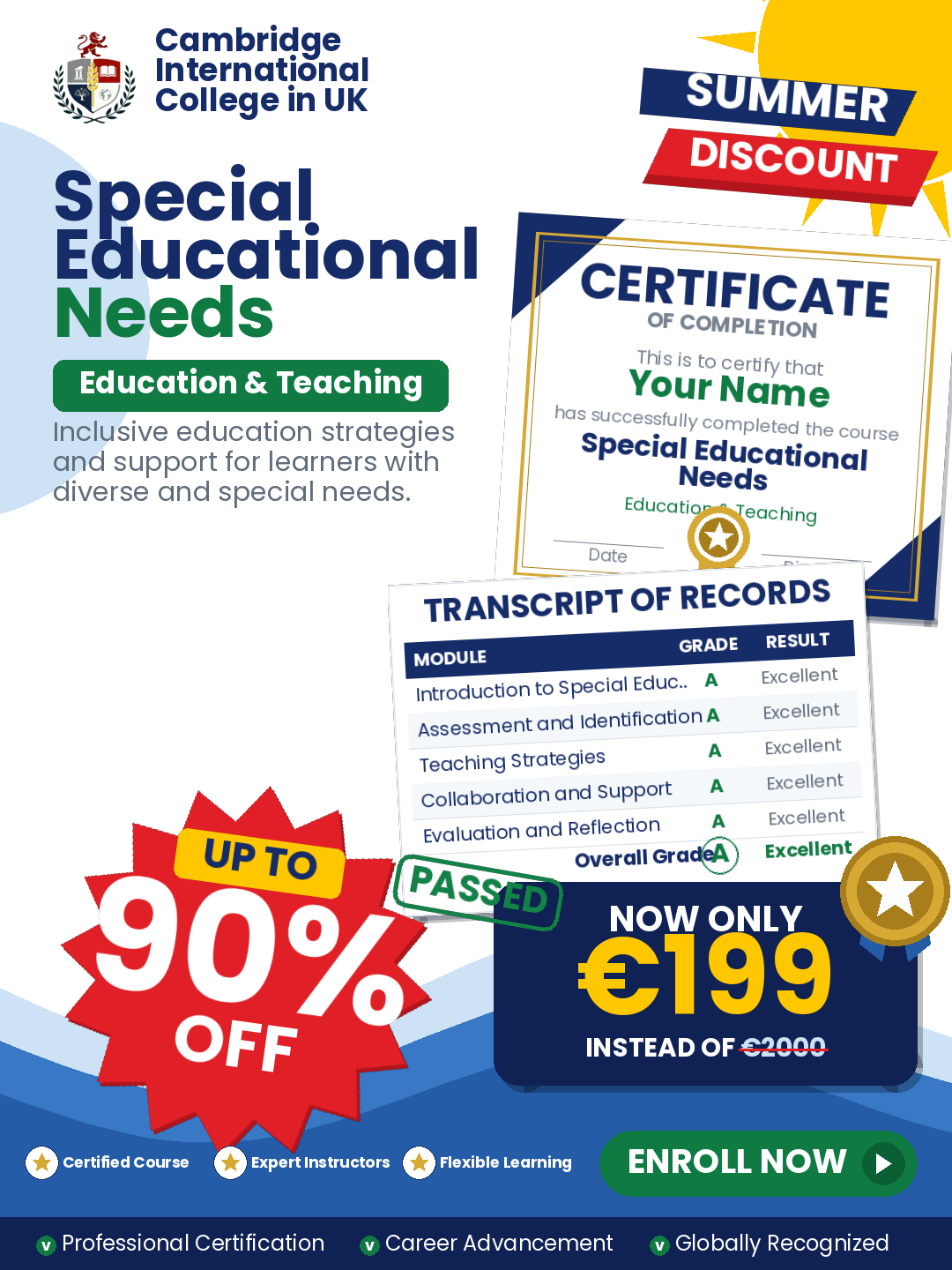
Special Educational Needs
Inclusive education strategies and support for learners with diverse and special needs.
A closer look at your course
Course Overview
The Special Educational Needs course is designed to equip educators and professionals with the necessary skills and knowledge to support learners with diverse and special needs. This program emphasizes inclusive education strategies, ensuring that all students have access to quality education tailored to their individual requirements.
Delivered through a flexible blended learning model by Cambridge International College in the UK, this course offers a professional diploma pathway that provides both breadth and depth in the study of special educational needs. With a total of 180 credits, participants will engage in comprehensive learning experiences over a period of 14 months.
Why Choose This Course?
As the landscape of education continues to evolve, the need for trained professionals who can address the challenges faced by learners with special needs is more critical than ever. This course is ideal for:
- Teachers seeking to enhance their skills in inclusive education.
- Educational leaders aiming to implement effective strategies in their institutions.
- Support staff who work directly with students requiring additional assistance.
- Anyone interested in making a positive impact in the field of education.
By choosing this course, you will gain insights into various teaching methodologies, legal frameworks, and best practices that promote an inclusive learning environment.
Course Content
The curriculum of the Special Educational Needs course covers a wide range of topics essential for understanding and supporting learners with diverse needs. Key areas of study include:
- Understanding Special Educational Needs and Disabilities (SEND).
- Inclusive education policies and practices.
- Assessment and identification of learners' needs.
- Strategies for differentiation and personalized learning.
- Collaboration with families and professionals.
- Behavior management and support strategies.
- Legal and ethical considerations in special education.
Each module is designed to provide practical knowledge that can be applied in real-world educational settings, ensuring that you are well-prepared to support your students effectively.
Career Paths
Completing the Special Educational Needs course opens doors to various career opportunities in the education sector. Graduates can pursue roles such as:
- Special Education Teacher
- Inclusion Coordinator
- Educational Psychologist
- Learning Support Assistant
- Educational Consultant
- Policy Advisor in Education
These positions are crucial in shaping inclusive educational practices and ensuring that all learners receive the support they need to thrive.
Flexible Learning Environment
The blended learning format of this course allows participants to balance their studies with personal and professional commitments. With a combination of online modules and in-person workshops, you will have the flexibility to learn at your own pace while still benefiting from direct interaction with instructors and peers.
This approach not only enhances learning but also fosters a supportive community of educators who share your passion for inclusive education.
Conclusion
Embarking on the Special Educational Needs course is a significant step towards becoming a leader in inclusive education. With the skills and knowledge gained, you will be well-equipped to advocate for and support learners with diverse needs, ultimately contributing to a more equitable education system.
For more information about the course, including enrollment details and upcoming start dates, please visit our website.
What you’ll learn
Learning objectives drawn from the published course content.
- Distinguish classroom teaching responsibility from specialist decisions.
- Identify the scope of an authoritative source.
- Build a role map that preserves the learner's access to meaningful teaching.
- Gather a respectful account of the task difficulty.
- Distinguish reported experience from observed performance.
- Choose a relevant check without requiring unnecessary personal disclosures.
Show all 54 learning objectives
- Distinguish different reasons for an incomplete criterion response.
- Design checks that discriminate rather than label.
- Plan a feasible sequence and evidence route.
- Audit the information retained in an alternative resource.
- Distinguish readability support from supplied reasoning.
- Interpret an access trial within its actual evidence scope.
- Explain a text-based decision through a model.
- Diagnose a plausible relevance error.
- Plan a fresh independent check beyond reproduction.
- Identify the reasoning a scaffold supplies.
- Preserve criterion demand and actual support records.
- Choose a fading condition and fresh independent evidence.
- Set an inspectable outcome rather than an activity label.
- Connect support with a specific evidence question.
- Define roles and review triggers without inventing formal provision decisions.
- Allocate assistant time against actual tasks.
- Distinguish observation, prompting and supplied reasoning.
- Retain teacher coordination and pupil-owned evidence.
- Describe strengths, gaps and support conditions accurately.
- Use authorised communication and coordination.
- Distinguish learning-support review from welfare action or clinical conclusions.
- Distinguish planned and actual support and timing.
- Preserve reasoning ownership.
- Recover unresolved evidence through a later observed opportunity.
- Reconcile paired criterion outcomes and measures.
- Distinguish independent learning from adult-produced work.
- Make a conditional revision without causal or diagnostic overclaim.
- Frame a bounded coordination question.
- Separate classroom evidence from specialist findings.
- Preserve teaching responsibility and appropriate information boundaries during referral.
- Compare an intervention's claimed target with the observed learning difficulty.
- Distinguish implementation from learning evidence.
- Design a bounded review without promising causal certainty.
- Identify what an access tool changes.
- Separate transcription or presentation assistance from supplied reasoning.
- Plan a feasible, bounded trial and retain a usable alternative.
- Identify which support assumptions change at transition.
- Prepare a purposeful handover.
- Review independent learning under new conditions without inventing formal provision.
- Separate opportunity, support and independent outcome counts.
- Interpret missing records without inventing failure or success.
- Design proportionate follow-up while protecting confidentiality.
- Test a proposed allocation against actual capacity.
- Preserve teacher planning and pupil ownership.
- Escalate unmet requirements without fabricating provision or lowering the criterion silently.
- Integrate classroom evidence with advanced coordination decisions.
- Defend assistance, numerical and authority boundaries.
- Use a consistent practice rubric to revise an accountable support plan.
Inside the curriculum
Explore the published modules and lessons. Full lesson content is available through your student account, with free enrolment. Learning sequence and administrative access controls still apply.
01Responsibility,Learner Voice and Needs Hypotheses3 lessons
Distinguish classroom teaching responsibility from specialist decisions. Gather a respectful account of the task difficulty. Distinguish different reasons for an incomplete criterion response.
- Mapping Responsibility Before Selecting Support
- Listening to a Learner's Task Experience
- Testing Access, Concept and Support Hypotheses
02Accessible Resources,Instruction and Scaffolds3 lessons
Audit the information retained in an alternative resource. Explain a text-based decision through a model. Identify the reasoning a scaffold supplies.
- Making Information Accessible Without Supplying the Answer
- Modelling the Link Between Main Point and Evidence
- Fading Support While Preserving Pupil Reasoning
03Support Planning,Adult Coordination and Communication3 lessons
Set an inspectable outcome rather than an activity label. Allocate assistant time against actual tasks. Describe strengths, gaps and support conditions accurately.
- Turning a Needs Hypothesis Into a Reviewable Support Plan
- Coordinating Limited Adult Time Without Replacing Learning
- Communicating Classroom Findings Through Appropriate Routes
04Delivery,Evaluation and Professional Coordination3 lessons
Distinguish planned and actual support and timing. Reconcile paired criterion outcomes and measures. Frame a bounded coordination question.
- Recording the Support That Was Actually Delivered
- Evaluating Support With Comparable Learning Evidence
- Coordinating Professional Evidence Without Inventing a Diagnosis
05Intervention Fit,Access Tools and Transition3 lessons
Compare an intervention's claimed target with the observed learning difficulty. Identify what an access tool changes. Identify which support assumptions change at transition.
- Selecting an Intervention Through Fit and a Reviewable Enquiry
- Trialling an Access Tool While Preserving the Assessed Construct
- Transferring Support Into a Different Classroom Context
06Provision Audit,Capacity and Integrated Support Defence3 lessons
Separate opportunity, support and independent outcome counts. Test a proposed allocation against actual capacity. Integrate classroom evidence with advanced coordination decisions.
- Auditing Provision Evidence Without Concealing Who Was Missed
- Allocating Adult Support Without Promising Impossible Time
- Capstone: Defending an Integrated Support Coordination Dossier
Is this course for you?
Who this is for
Teachers,education coordinators and support leaders developing bounded intervention,access,transition,audit and deployment decisions. Eleven reviewed certificate foundations are intentionally reused and extended with seven advanced lessons.
Before you begin
Basic teaching knowledge and professional English. Fictional task evidence only;no clinical assessment or real pupil-data collection required.
Who this is not for
This is not clinical diagnosis,therapy,legal determination,automatic provision eligibility or authority to investigate private family circumstances.
Assessment & completion
20 scenario questions, 5 marks each (100 total), covering every lesson. Complete required lessons and select every correct answer before submission. Portfolio/capstone activities support self or instructor review; the portal does not collect or automatically grade projects and they are not an additional certificate gate. Credit allocation awaits institutional approval.
Materials & resources
6 modules with 18 complete lessons, reviewed sources, a connected fictional case, practice portfolio, scored capstone rubric and reusable template.
Your questions, answered
What is the duration of the course?
The course lasts for 14 months, allowing for flexible study options.
Is this course fully online?
No, it is a blended learning course that combines online and in-person components.
What qualifications will I receive?
Upon successful completion, you will receive a professional diploma in Special Educational Needs.
Are there any prerequisites for this course?
Yes, a secondary education and a basic understanding of educational theories are required.
Can I work while studying?
Yes, the flexible nature of the course allows you to balance work and study commitments.
Cancellation policy
Students may cancel their enrollment within 14 days of the start date for a full refund. After this period, no refunds will be issued.
Course inquiry
Send a message about Special Educational Needs. Our team will reply by email or phone.