Information Technology
Essential IT skills covering systems, networks, software applications, and digital workplace tools.
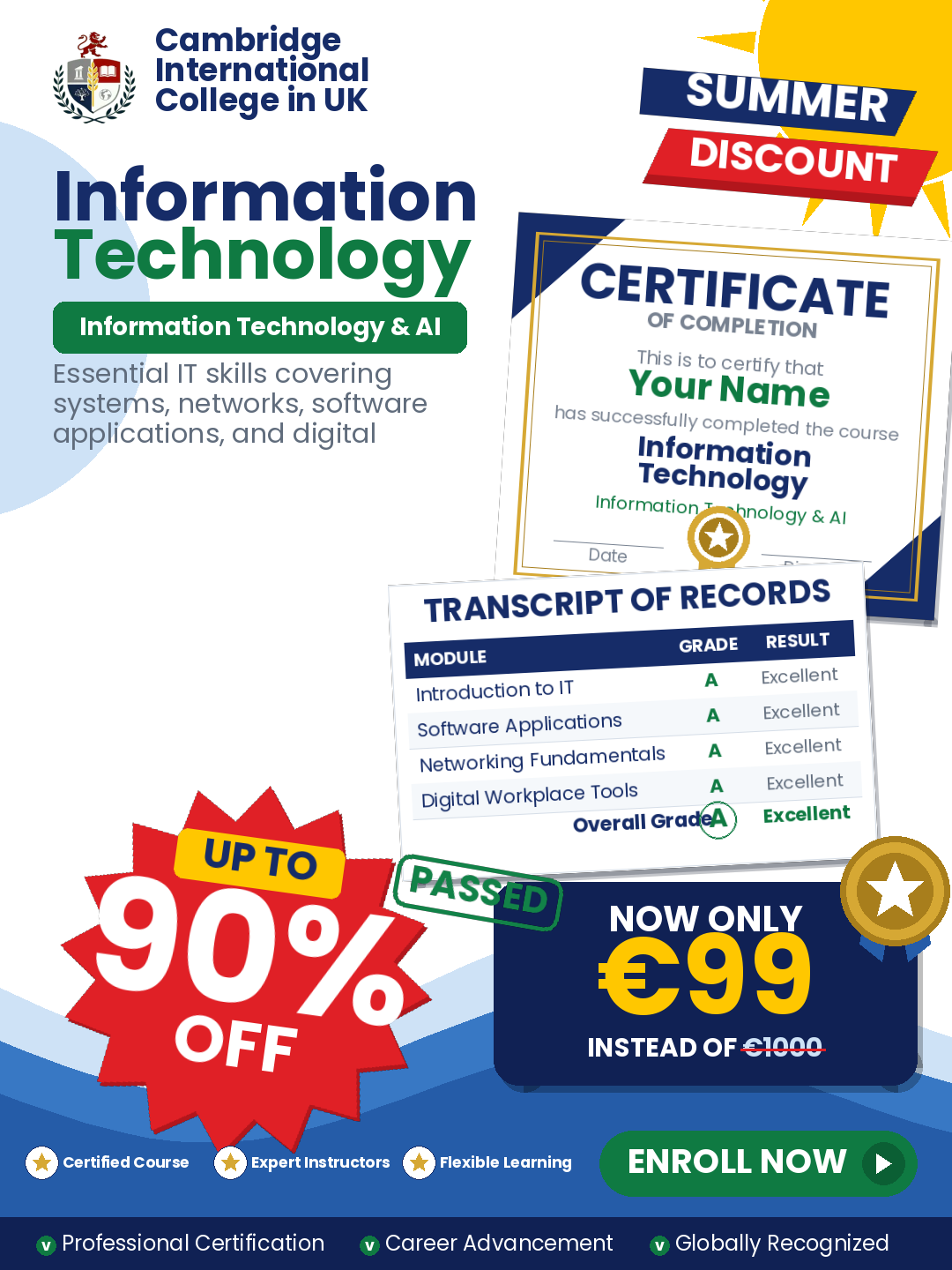
A closer look at your course
About the Course
The Information Technology Certificate program is designed to equip learners with essential IT skills that are crucial in today’s digital landscape. This course covers a wide range of topics including systems, networks, software applications, and digital workplace tools. Delivered through a flexible blended learning approach by Cambridge International College in the UK, this program is tailored to meet the needs of both aspiring IT professionals and those looking to enhance their existing skills.
Course Overview
In an era where technology is rapidly evolving, having a solid foundation in information technology is more important than ever. This course provides a comprehensive overview of key IT concepts and practices, ensuring that students are well-prepared for the challenges of the modern workplace.
The course duration is flexible, spanning from 3 to 6 months, allowing students to learn at their own pace while balancing other commitments. The blended learning format combines online study with in-person sessions, providing a rich and interactive learning experience.
Key Topics Covered
Throughout the course, students will explore a variety of essential topics, including:
- Understanding computer systems and their components
- Networking fundamentals and protocols
- Software applications and productivity tools
- Digital workplace tools and collaboration platforms
- Cybersecurity basics and best practices
- Data management and storage solutions
Each module is designed to build upon the previous one, ensuring a cohesive and comprehensive understanding of the subject matter.
Career Paths
Completing the Information Technology Certificate opens up a variety of career opportunities in the IT field. Graduates can pursue roles such as:
- IT Support Specialist
- Network Administrator
- Systems Analyst
- Software Developer
- Cybersecurity Analyst
- Data Analyst
The skills acquired through this program are highly valued by employers, making graduates competitive candidates in the job market.
Skills Developed
Students will develop a range of skills that are critical for success in the IT industry, including:
- Problem-solving and analytical thinking
- Technical proficiency in various software and tools
- Effective communication and collaboration skills
- Understanding of IT security protocols
- Ability to manage and analyze data
These skills not only enhance employability but also prepare students for further studies in the field of information technology.
Why Choose Cambridge International College?
Cambridge International College is renowned for its commitment to providing high-quality education and training. With a focus on practical skills and real-world applications, the college prepares students to thrive in their chosen careers. The blended learning approach offers flexibility and convenience, making it easier for students to integrate their studies with their personal and professional lives.
Additionally, students will benefit from access to a wealth of resources, including experienced instructors, online learning materials, and a supportive learning community.
Enroll Today
Take the first step towards a rewarding career in information technology by enrolling in the Information Technology Certificate program. With flexible learning options and a comprehensive curriculum, you will gain the knowledge and skills needed to succeed in the ever-evolving IT landscape.
For more information on course details, enrollment procedures, and upcoming start dates, please visit our website or contact our admissions office.
“The Information Technology Certificate program has transformed my career. The skills I gained have opened doors I never thought possible!”
- A satisfied graduate
Don’t miss this opportunity to enhance your IT skills and advance your career. Join us at Cambridge International College and become a part of the future of technology!
What you’ll learn
Learning objectives drawn from the published course content.
- Identify hardware, software, data, network and people dependencies.
- Separate a service requirement from a product choice.
- Bound an improvement proposal by actual evidence and authority.
- Distinguish working memory, persistent storage and software roles.
- Interpret an inventory within its limits.
- Plan authorised support without diagnosing from one specification.
Show all 36 learning objectives
- Define a controlled file/version record.
- Distinguish current access, synchronisation and recoverable copies.
- Plan a bounded restore check without altering real data.
- Map a simple network request at a conceptual level.
- Distinguish name resolution from service availability.
- Record a useful bounded connectivity report.
- Define identifiers, categories and numeric units.
- Detect duplicate or missing records without silently repairing them.
- Separate a data-quality check from proof of real-world accuracy.
- Translate a small dataset into labelled cells.
- Distinguish copied relative and absolute references.
- Verify formulas against expected results and scope.
- Distinguish table rows, columns and keys.
- Apply a read-only filter and explicit ordering.
- Interpret a query result within the supplied dataset and permissions.
- Distinguish identity verification from permitted actions.
- Apply task-based access reasoning.
- Record sharing, approval and review without collecting credentials.
- Write a reproducible symptom record.
- Distinguish a hypothesis from a confirmed cause.
- Plan a proportionate authorised check and verify the intended service afterward.
- Identify information and dependency needs for recovery.
- Specify a safe restore acceptance check.
- Distinguish a successful sample from complete service continuity.
- Choose measures tied to the intended service.
- Separate operational records from test outcomes and user experience.
- Make a conditional decision with honest population and causality limits.
- Integrate service dependencies, data and controlled support.
- Defend formula, query and recovery evidence within scope.
- Use a transparent practice rubric to revise an accountable recommendation.
Inside the curriculum
Explore the published modules and lessons. Full lesson content is available through your student account, with free enrolment. Learning sequence and administrative access controls still apply.
01Service Systems,Devices and Controlled Files3 lessons
Identify hardware, software, data, network and people dependencies. Distinguish working memory, persistent storage and software roles. Define a controlled file/version record.
- Mapping an Information Service Beyond Its Devices
- Reading Device and Software Evidence Before Changing Equipment
- Organising Files Without Confusing Synchronisation and Recovery
02Networks,Data Meaning and Spreadsheet Logic3 lessons
Map a simple network request at a conceptual level. Define identifiers, categories and numeric units. Translate a small dataset into labelled cells.
- Separating Local Connectivity, Name Resolution and Remote Service Status
- Preserving Data Meaning Before Calculating a Result
- Building a Checkable Spreadsheet With Stable References
03Database Queries,Access and Support3 lessons
Distinguish table rows, columns and keys. Distinguish identity verification from permitted actions. Write a reproducible symptom record.
- Reading a Small Database Without Changing Its Records
- Planning Account Access and Sharing by Task and Authority
- Troubleshooting Through Bounded Evidence and Controlled Changes
04Recovery,Service Evaluation and Integrated IT Defence3 lessons
Identify information and dependency needs for recovery. Choose measures tied to the intended service. Integrate service dependencies, data and controlled support.
- Testing Recovery as a Service Decision Rather Than a Copy Count
- Evaluating an IT Change With More Than a Convenient Dashboard
- Capstone: Defending an Integrated IT Service and Data Portfolio
Is this course for you?
Who this is for
Office staff,aspiring IT coordinators and learners connecting devices,networks,data,applications,access and accountable service support.
Before you begin
Basic reading,arithmetic and everyday device use;all fictional records,formulas and query examples supplied. Paper-only learning is sufficient;optional practice uses isolated fictional data.
Who this is not for
Not vendor certification,production administration,penetration testing,credential collection,legal advice,financial advice or authority to alter live systems.
Assessment & completion
20 scenario questions, 5 marks each (100 total), covering every lesson. Complete required lessons and select every correct answer before submission. Portfolio/capstone activities support self or instructor review; the portal does not collect or automatically grade projects and they are not an additional certificate gate. Credit allocation awaits institutional approval.
Materials & resources
4 modules with 12 complete lessons, reviewed sources, a connected fictional case, practice portfolio, scored capstone rubric and reusable template.
Your questions, answered
What prior knowledge do I need?
A basic understanding of computers and software is recommended.
How is the course delivered?
The course is delivered through a blended learning format, combining online and in-person sessions.
What is the duration of the course?
The course duration is flexible, typically completed within 3 to 6 months.
Will I receive a certificate?
Yes, a certificate will be awarded upon successful completion of the course.
Cancellation policy
Students may cancel their enrollment up to 14 days before the course start date for a full refund.
Course inquiry
Send a message about Information Technology. Our team will reply by email or phone.