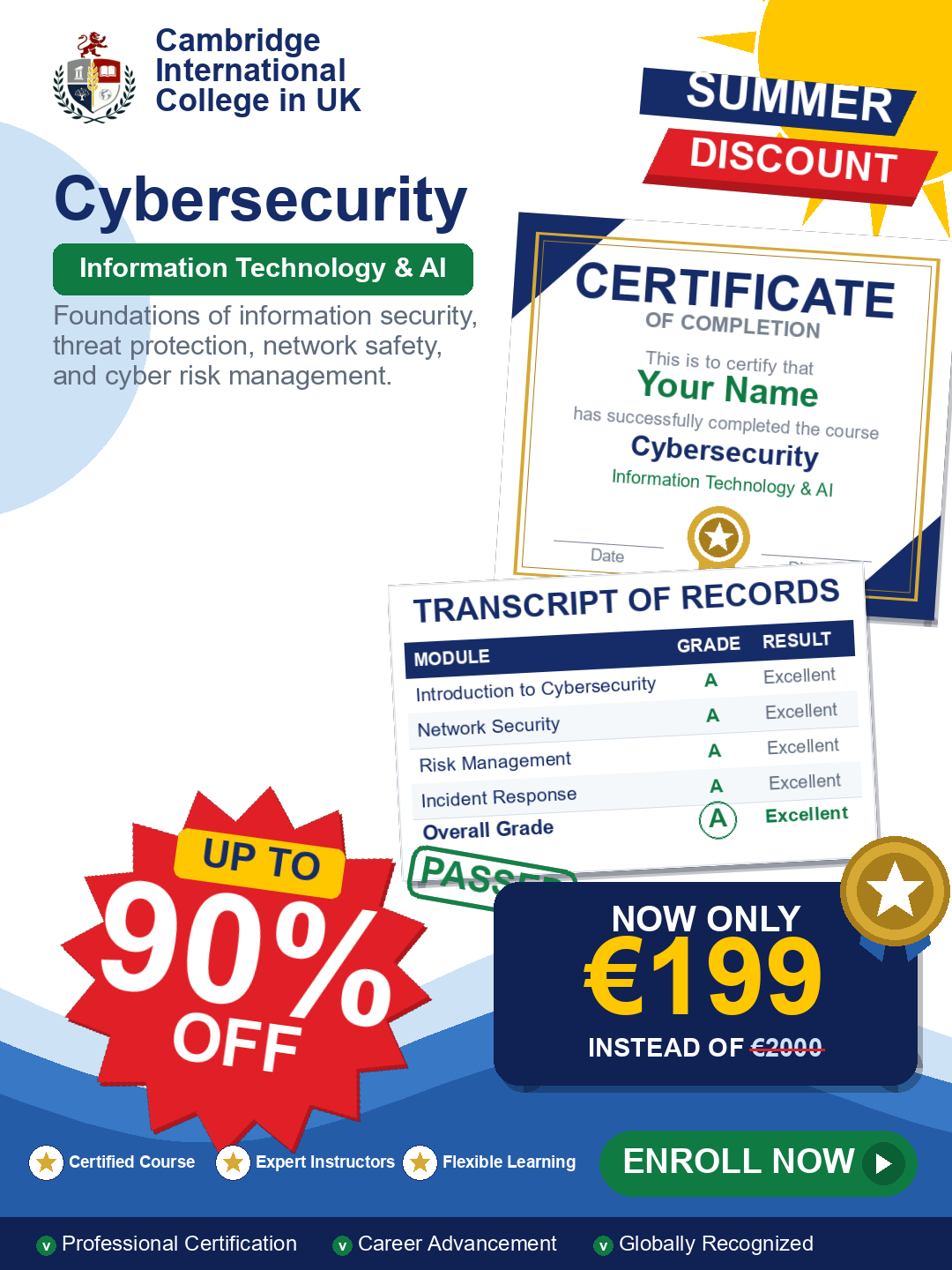
Cybersecurity
Foundations of information security, threat protection, network safety, and cyber risk management.
A closer look at your course
About the Cybersecurity Program
The Cybersecurity program at Cambridge International College is designed to equip students with the foundational knowledge and skills necessary to navigate the complex world of information security. As cyber threats continue to evolve, this program provides a comprehensive understanding of threat protection, network safety, and cyber risk management.
This professional diploma pathway offers a flexible blended learning approach, allowing students to balance their studies with personal and professional commitments. Over the course of 14 months, students will engage with a curriculum that covers a wide range of topics essential for a career in cybersecurity.
Program Structure
The program consists of 180 credits, structured to provide both breadth and depth in cybersecurity education. Students will participate in a mix of online coursework and in-person sessions, ensuring they gain both theoretical knowledge and practical experience.
Throughout the program, students will explore various aspects of cybersecurity, including network security protocols, risk assessment methodologies, and incident response strategies. This holistic approach prepares graduates to effectively address real-world security challenges.
Who Should Enroll?
This program is ideal for individuals looking to start or advance their careers in the field of cybersecurity. Whether you are a recent graduate or a professional seeking to enhance your skills, this program offers valuable insights and practical knowledge.
Who Should Not Enroll?
Individuals not interested in technology or those unwilling to commit time to study may find this program challenging. Additionally, those seeking a purely theoretical understanding without practical application may not benefit from this course.
Get Started Today!
Join the Cybersecurity program at Cambridge International College and take the first step towards a rewarding career in one of the most critical fields in today’s digital landscape. With our flexible learning options and comprehensive curriculum, you’ll be well-prepared to meet the demands of the cybersecurity industry.
What you’ll learn
Learning objectives drawn from the published course content.
- Identify important digital services and their owners.
- Distinguish an asset inventory from assurance.
- Set an authorised, non-invasive learning scope.
- Distinguish a weakness, a threat and an observed event.
- Prioritise with stated reasoning.
- Avoid treating ordinal scores as measured probabilities.
Show all 54 learning objectives
- Match access to job responsibilities.
- Separate standard work from administration.
- Plan review and removal without exposing credentials.
- Distinguish authentication from authorisation.
- Evaluate sign-in coverage using denominators.
- Keep recovery methods within controlled responsibilities.
- Distinguish support status from current update status.
- Plan a controlled change and verification.
- Preserve a usable service fallback.
- Distinguish copying, synchronisation and tested restoration.
- Interpret partial recovery results.
- Specify recovery objectives as proposals rather than observations.
- Identify risky actions requested by a message.
- Verify through an independently established route.
- Record uncertainty without interacting with suspect content.
- Separate observations, reports and hypotheses.
- Assign proportionate escalation.
- Preserve evidence without exceeding technical authority.
- Define a service-level recovery acceptance check.
- Separate containment, restoration and resumption.
- Preserve unresolved data and evidence questions.
- Write evidence-bounded updates for different audiences.
- Separate service status from cause and scope.
- Identify reporting questions for the responsible institution.
- Interpret control coverage and exercise results.
- Distinguish activity measures from effective protection.
- Recommend a conditional improvement with an owner.
- Separate operational ownership from risk acceptance.
- Build a reviewable exception record.
- Keep approval, implementation and verification distinct.
- Map a supplier dependency and access route.
- Distinguish contractual statements from operating evidence.
- Plan an accountable approval and exit process.
- Trace a plausible service-failure path.
- Distinguish assumptions from observed vulnerabilities.
- Select a control and an evidence-based review question.
- Interpret the scope of a supplied log extract.
- Reconcile conflicting reports without inventing certainty.
- Plan proportionate authorised evidence collection.
- Design an authorised discussion exercise.
- Distinguish response proposals from tested capabilities.
- Record lessons and accountable improvement actions.
- Distinguish coverage, activity and outcome measures.
- Interpret a changed inventory denominator.
- Prioritise improvements without claiming an unmeasured security effect.
- Defend an integrated service-protection proposal.
- Reconcile evidence, assumptions and authority.
- Apply one original practice rubric to a coherent professional portfolio.
Inside the curriculum
Explore the published modules and lessons. Full lesson content is available through your student account, with free enrolment. Learning sequence and administrative access controls still apply.
01Services,Risk and Account Responsibility3 lessons
Identify important digital services and their owners. Distinguish a weakness, a threat and an observed event. Match access to job responsibilities.
- Mapping Important Services, Information and Dependencies
- Turning Observations Into Prioritised Risk Decisions
- Assigning Access and Reviewing Joiners, Movers and Leavers
02Protection and Recoverability3 lessons
Distinguish authentication from authorisation. Distinguish support status from current update status. Distinguish copying, synchronisation and tested restoration.
- Improving Sign-In Protection and Recovery Readiness
- Planning Supported Devices and Verified Updates
- Testing a Recovery Copy Instead of Trusting a Backup Label
03Detection,Response and Service Recovery3 lessons
Identify risky actions requested by a message. Separate observations, reports and hypotheses. Define a service-level recovery acceptance check.
- Evaluating Suspicious Requests Through an Independent Channel
- Building an Incident Timeline From Known Facts
- Rehearsing Recovery and Verifying Service Readiness
04Communication,Review and Governance3 lessons
Write evidence-bounded updates for different audiences. Interpret control coverage and exercise results. Separate operational ownership from risk acceptance.
- Communicating Incidents Without Inventing Certainty
- Reviewing Controls and Choosing the Next Improvement
- Establishing Accountable Security Decisions and Exceptions
05Supplier,Scenario and Evidence Analysis3 lessons
Map a supplier dependency and access route. Trace a plausible service-failure path. Interpret the scope of a supplied log extract.
- Reviewing Supplier Access and Shared Responsibilities
- Modelling Failure Scenarios Without Testing Unauthorised Systems
- Interpreting Logs, Missing Coverage and Conflicting Reports
06Exercises,Measurement and Accountable Resilience3 lessons
Design an authorised discussion exercise. Distinguish coverage, activity and outcome measures. Defend an integrated service-protection proposal.
- Evaluating an Incident Tabletop and Its Recovery Decisions
- Building a Measurement and Improvement Plan With Honest Denominators
- Capstone: Cybersecurity Governance and Service Resilience Portfolio
Is this course for you?
Who this is for
Staff,trainers and service leaders connecting cybersecurity controls to supplier dependencies,governance,evidence interpretation and accountable resilience planning.
Before you begin
Basic use of digital services and simple proportions;paper-only practice is sufficient and no live system access is required.
Who this is not for
Not penetration testing,credential collection,malware analysis,legal reporting advice,product certification or a guarantee of secure systems.
Assessment & completion
20 scenario questions, 5 marks each (100 total), covering every lesson. Complete required lessons and select every correct answer before submission. Portfolio/capstone activities support self or instructor review; the portal does not collect or automatically grade projects and they are not an additional certificate gate. Credit allocation awaits institutional approval.
Materials & resources
6 modules with 18 complete lessons, reviewed sources, a connected fictional case, practice portfolio, scored capstone rubric and reusable template.
Your questions, answered
What is the duration of the program?
The program lasts for 14 months, allowing for flexible study options.
Is there a final exam?
Yes, students will complete a final exam along with various projects throughout the course.
What kind of support will I receive?
Students will have access to academic support and resources throughout their studies.
Can I work while studying?
Yes, the flexible nature of the program allows you to balance work and study.
Cancellation policy
Students may cancel their enrollment within 14 days of the start date for a full refund.
Course inquiry
Send a message about Cybersecurity. Our team will reply by email or phone.