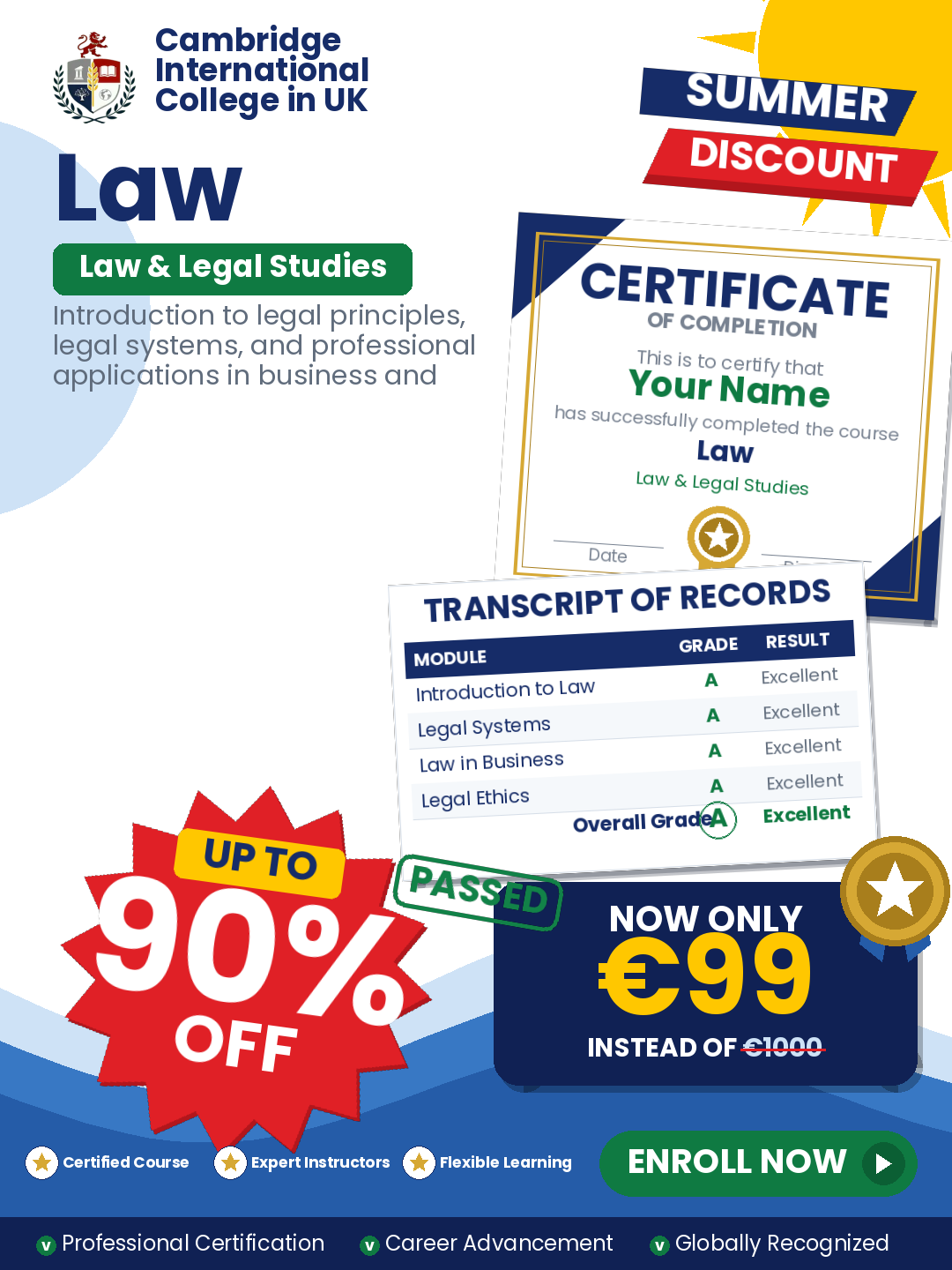
Law
Introduction to legal principles, legal systems, and professional applications in business and society.
A closer look at your course
About the Course
Welcome to the Law Certificate Program offered by Cambridge International College. This course provides a comprehensive introduction to the essential legal principles and systems that underpin our society and business practices. Designed for those seeking to enhance their understanding of the law, this program is delivered through a flexible blended learning approach, allowing you to study at your own pace.
Course Overview
The Law Certificate Program spans a duration of 3–6 months, providing you with the flexibility to tailor your learning experience to fit your schedule. The course is structured to cover key legal concepts, frameworks, and applications, ensuring that you gain a solid foundation in legal studies.
Throughout this program, you will explore various legal systems, understand the role of law in society, and examine the implications of legal principles in business contexts. This course is ideal for individuals looking to pursue a career in law or enhance their professional skills in a legal environment.
Career Paths
The skills and knowledge acquired through this program can open doors to various career opportunities in the legal field. Graduates of the Law Certificate Program may pursue roles such as:
- Legal Assistant
- Paralegal
- Compliance Officer
- Corporate Legal Advisor
- Human Resources Specialist
- Policy Analyst
Whether you are looking to start a new career or enhance your current role, this course equips you with the necessary skills to navigate the complexities of legal issues in today’s business environment.
Flexible Learning Experience
Our blended learning approach combines online coursework with in-person sessions, offering a dynamic and interactive learning experience. You will have access to a range of resources, including:
- Online lectures and reading materials.
- Interactive discussion forums.
- Case studies and real-world applications.
- Access to legal databases and research tools.
This flexible structure allows you to engage with the material at your convenience while still benefiting from direct interaction with instructors and peers.
Support and Resources
At Cambridge International College, we are committed to supporting our students throughout their learning journey. You will have access to:
- Dedicated academic advisors to guide you.
- Online resources and study materials.
- Networking opportunities with industry professionals.
- Career services to assist with job placement and internships.
Our goal is to ensure that you have the tools and support needed to succeed in your studies and future career.
Enroll Today
Take the first step towards a rewarding career in law by enrolling in the Law Certificate Program at Cambridge International College. Our program is designed to provide you with the knowledge and skills necessary to thrive in a legal environment.
For more information about the course, including enrollment details and tuition fees, please visit our website or contact our admissions team. We look forward to welcoming you to our vibrant academic community!
What you’ll learn
Learning objectives drawn from the published course content.
- Classify different kinds of legal and organisational material.
- Explain why a source's authority and scope matter.
- Build an evidence register that does not turn a proposal into a legal obligation.
- Distinguish civil and criminal questions at an introductory level.
- Identify jurisdiction and party information needed before selecting a route.
- Explain why a court diagram does not establish a particular claim's merits or procedure.
Show all 36 learning objectives
- Read a legal provision together with defined terms and cross-references.
- Distinguish enactment, commencement and a source's version date.
- Record the limits of a selected statutory reading without claiming a complete legal audit.
- Build a chronology from original documents.
- Distinguish observation, reported statement and inference.
- Reconcile quantities without treating a discrepancy as a final finding of liability.
- Separate an order, agreement, performance and proposed variation.
- Build a term-to-evidence comparison using the supplied transaction.
- Explain why an internal approval rule and an external contractual obligation are different questions.
- Apply the selected statutory consumer definition to supplied facts.
- Identify the evidence relevant to a quality issue.
- Separate a possible statutory breach from assumptions about cause and available remedies.
- Reconcile purchase quantities and payments without double counting.
- Distinguish a remedy request, negotiated proposal and adjudicated entitlement.
- Identify which conditions require further legal and factual verification.
- Distinguish informal clarification, negotiated settlement and adjudication.
- Explain the mediator's role without assuming every process is optional or identical.
- Prepare a route comparison that retains deadlines and authority questions.
- Specify the purpose and minimum necessary information for a legal enquiry.
- Preserve the distinction between an allegation and a finding.
- Design an access and referral record without claiming professional privilege or compliance certification.
- Connect a precise issue to an identified rule and relevant facts.
- Test an alternative interpretation rather than merely repeating a preferred answer.
- Write a conclusion that preserves conditions and the limits of the source.
- Draft a purpose-specific enquiry with accurate status language.
- Distinguish authority to prepare a draft from authority to send or settle.
- Propagate a material correction through linked analysis and calculations.
- Integrate source, jurisdiction, fact and remedy analysis into a reviewable dossier.
- Defend a conditional recommendation using supplied evidence and credible alternatives.
- Identify and correct material overclaims before relying on a practice score.
Inside the curriculum
Explore the published modules and lessons. Full lesson content is available through your student account, with free enrolment. Learning sequence and administrative access controls still apply.
01Authority,Jurisdiction and Reading Legal Sources3 lessons
Classify different kinds of legal and organisational material. Distinguish civil and criminal questions at an introductory level. Read a legal provision together with defined terms and cross-references.
- Separating Law, Guidance and an Organisation's Own Policy
- Identifying the Legal Question Before Choosing a Forum
- Reading a Provision with Its Definitions and Time Context
02Evidence,Contract Issues and Consumer Scope3 lessons
Build a chronology from original documents. Separate an order, agreement, performance and proposed variation. Apply the selected statutory consumer definition to supplied facts.
- Reconstructing a Dispute from the Complete Original Records
- Analysing Agreed Terms and Performance Without Inventing Agreement
- Applying a Consumer Definition Before Analysing Quality
03Remedies,Dispute Routes and Information Handling3 lessons
Reconcile purchase quantities and payments without double counting. Distinguish informal clarification, negotiated settlement and adjudication. Specify the purpose and minimum necessary information for a legal enquiry.
- Separating a Requested Remedy from a Proven Monetary Entitlement
- Comparing Clarification, Mediation and Court Processes
- Handling Legal Enquiry Records Without Oversharing
04Reasoning,Communication and Integrated Legal Defence3 lessons
Connect a precise issue to an identified rule and relevant facts. Draft a purpose-specific enquiry with accurate status language. Integrate source, jurisdiction, fact and remedy analysis into a reviewable dossier.
- Writing an Issue, Rule, Application and Bounded Conclusion
- Communicating a Neutral Enquiry and Revising It When Facts Change
- Capstone: Complete Introductory Legal Reasoning Portfolio
Is this course for you?
Who this is for
Learners and organisational staff developing introductory legal literacy,source reading,fact classification,structured reasoning and appropriate referral using an England-and-Wales case.
Before you begin
Introductory reading and arithmetic. Complete fictional dossier,rule card and communication supplied;no real dispute,personal data or court activity required.
Who this is not for
Not a qualifying law degree,practising entitlement,professional representation,individual legal advice,live investigation or complete consumer/contract/procedure/compliance audit.
Assessment & completion
20 scenario questions, 5 marks each (100 total), covering every lesson. Complete required lessons and select every correct answer before submission. Portfolio/capstone activities support self or instructor review; the portal does not collect or automatically grade projects and they are not an additional certificate gate. Credit allocation awaits institutional approval.
Materials & resources
4 modules with 12 complete lessons, reviewed sources, a connected fictional case, practice portfolio, scored capstone rubric and reusable template.
Your questions, answered
What is the duration of the course?
The course lasts between 3 to 6 months, depending on your pace.
Is this course fully online?
No, it is a blended learning course, combining online and in-person elements.
What materials will I need?
You will need access to a computer and internet, along with the provided course materials.
Will I receive a certificate upon completion?
Yes, a certificate of completion will be awarded after successfully finishing the course.
Cancellation policy
Students may cancel their enrollment up to two weeks before the course starts for a full refund. No refunds will be issued after this period.
Course inquiry
Send a message about Law. Our team will reply by email or phone.