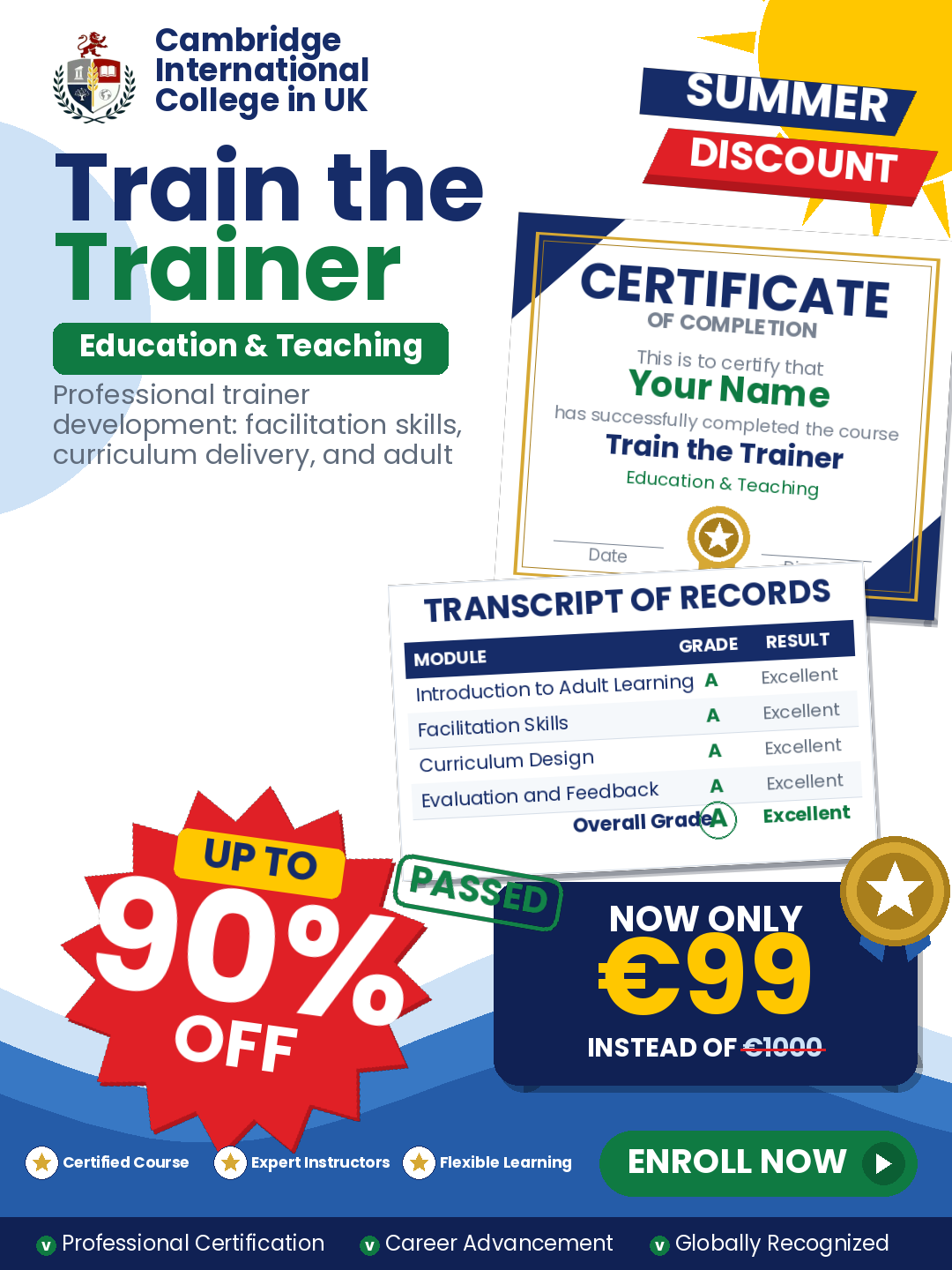
Train the Trainer
Professional trainer development: facilitation skills, curriculum delivery, and adult learning methods.
A closer look at your course
About the Course
The Train the Trainer course is designed for individuals who aspire to enhance their skills as professional trainers. This program focuses on key areas such as facilitation skills, curriculum delivery, and adult learning methods, ensuring that participants are well-equipped to engage and educate effectively. Delivered through a flexible blended learning format by Cambridge International College in the UK, this course is tailored to meet the diverse needs of modern educators.
Course Objectives
Throughout the duration of the course, participants will:
- Develop effective facilitation skills that foster an engaging learning environment.
- Learn to design and deliver impactful training sessions tailored to adult learners.
- Explore various adult learning theories and apply them in practice.
- Gain insights into the assessment and evaluation of training effectiveness.
- Enhance their communication and presentation skills for diverse audiences.
Course Structure
The Train the Trainer program spans a flexible duration of 3 to 6 months, allowing participants to balance their studies with personal and professional commitments. The blended learning approach combines online coursework with in-person workshops, providing a comprehensive learning experience.
Participants will engage with a variety of learning materials, including video lectures, interactive discussions, and practical assignments. This multifaceted approach ensures that learners can absorb and apply knowledge effectively.
Who Should Enroll?
This course is ideal for:
- Current trainers seeking to refine their skills and methodologies.
- Professionals transitioning into training roles from other fields.
- Educators looking to enhance their teaching techniques.
- Human resources personnel involved in employee development.
- Anyone passionate about sharing knowledge and facilitating learning.
Key Skills Developed
Participants will emerge from the course with a robust set of skills, including:
- Facilitation Skills: Master techniques to guide discussions and encourage participation.
- Curriculum Development: Create training programs that meet the needs of adult learners.
- Assessment Techniques: Learn how to evaluate the effectiveness of training sessions.
- Communication: Enhance verbal and non-verbal communication skills for diverse settings.
- Adaptability: Tailor training approaches to suit different learning styles and environments.
Certification
Upon successful completion of the course, participants will receive a Certificate in Train the Trainer from Cambridge International College. This certification is recognized globally and serves as a testament to the skills and knowledge acquired during the program.
Career Opportunities
Graduates of the Train the Trainer course can pursue various career paths, including:
- Corporate Trainer
- Instructional Designer
- Training and Development Manager
- Educational Consultant
- Human Resources Development Specialist
Conclusion
Investing in your professional development through the Train the Trainer course can significantly enhance your career prospects and effectiveness as an educator. With the support of expert trainers and a rich curriculum, you will be empowered to make a lasting impact on learners in your organization or community.
Join us at Cambridge International College and take the first step towards becoming a transformative trainer today!
What you’ll learn
Learning objectives drawn from the published course content.
- Separate a performance observation from an assumed training need.
- Identify information that distinguishes knowledge and workplace barriers.
- Define an accountable training enquiry.
- Write an observable learner objective.
- Align assessment with the intended performance.
- Distinguish an administrative activity from evidence of learning.
Show all 36 learning objectives
- Build a feasible session sequence.
- Connect explanation, practice and checking to component needs.
- Account for time without silently removing essential learner work.
- Audit the accuracy of participant materials.
- Preserve access without supplying assessed decisions.
- Distinguish scenario information from real operational authority.
- Make a model's reasoning visible.
- Use a contrasting case to expose a decision boundary.
- Reduce supplied content before inspecting independent performance.
- Link feedback to a specific performance component.
- Preserve useful learner work while correcting a gap.
- Plan revision and a later independent check.
- Create participation routes connected to the learning goal.
- Respond to uneven contribution without stereotyping adults.
- Preserve individual evidence within collaborative activity.
- Construct an unfamiliar aligned assessment.
- Apply a criterion consistently and record assistance.
- Distinguish a local performance result from wider workplace competence.
- Reconcile planned and actual session time.
- Distinguish delivery gaps from evidence of learning failure.
- Plan a recovery with real resources and transparent status.
- Reconcile paired performance counts.
- Calculate clearly named changes.
- Separate descriptive learning evidence from causal and attendance claims.
- Distinguish course performance from workplace application.
- Identify environmental supports and barriers.
- Design a bounded follow-up with realistic ownership and information use.
- Integrate diagnosis, design and delivery evidence.
- Defend learning and transfer claims within their scope.
- Use a consistent practice rubric to revise a trainer portfolio.
Inside the curriculum
Explore the published modules and lessons. Full lesson content is available through your student account, with free enrolment. Learning sequence and administrative access controls still apply.
01Needs,Objectives and Session Design3 lessons
Separate a performance observation from an assumed training need. Write an observable learner objective. Build a feasible session sequence.
- Diagnosing Whether a Performance Gap Needs Training
- Defining a Performance Objective and Its Evidence
- Sequencing a Session Around Learning Rather Than Slide Coverage
02Materials,Modelling and Actionable Feedback3 lessons
Audit the accuracy of participant materials. Make a model's reasoning visible. Link feedback to a specific performance component.
- Creating a Complete and Usable Training Case Pack
- Modelling the Decision Process Without Turning Practice Into Copying
- Giving Feedback That Learners Can Use in a New Attempt
03Facilitation,Assessment and Actual Delivery3 lessons
Create participation routes connected to the learning goal. Construct an unfamiliar aligned assessment. Reconcile planned and actual session time.
- Facilitating Participation Without Mistaking Talk for Learning
- Assessing a New Handover With a Stable Criterion
- Recording Actual Delivery and Recovering Lost Practice
04Learning Evaluation,Transfer and Trainer Defence3 lessons
Reconcile paired performance counts. Distinguish course performance from workplace application. Integrate diagnosis, design and delivery evidence.
- Evaluating Learning Without Confusing Net Change and Individual Gains
- Supporting Workplace Application After the Course
- Capstone: Defending a Complete Trainer Design and Review Portfolio
Is this course for you?
Who this is for
New trainers,workplace facilitators and subject specialists designing and reviewing purposeful adult-learning sessions.
Before you begin
Professional reading and basic percentages;all required fictional training cases,procedure cards,templates and keys are supplied.
Who this is not for
Not external trainer accreditation,regulated occupational competence,clinical training,legal advice or authority to change real organisational procedures.
Assessment & completion
20 scenario questions, 5 marks each (100 total), covering every lesson. Complete required lessons and select every correct answer before submission. Portfolio/capstone activities support self or instructor review; the portal does not collect or automatically grade projects and they are not an additional certificate gate. Credit allocation awaits institutional approval.
Materials & resources
4 modules with 12 complete lessons, reviewed sources, a connected fictional case, practice portfolio, scored capstone rubric and reusable template.
Your questions, answered
What is the duration of the course?
The course duration is flexible, typically ranging from 3 to 6 months.
Is there a final exam?
There is no final exam, but participants will complete projects and assessments.
What technology do I need?
A computer with internet access is required to participate in the course.
Will I receive a certificate?
Yes, a certificate of completion will be awarded upon successfully finishing the course.
Cancellation policy
Participants may cancel their enrollment up to two weeks before the start date for a full refund. No refunds will be issued after this period.
Course inquiry
Send a message about Train the Trainer. Our team will reply by email or phone.