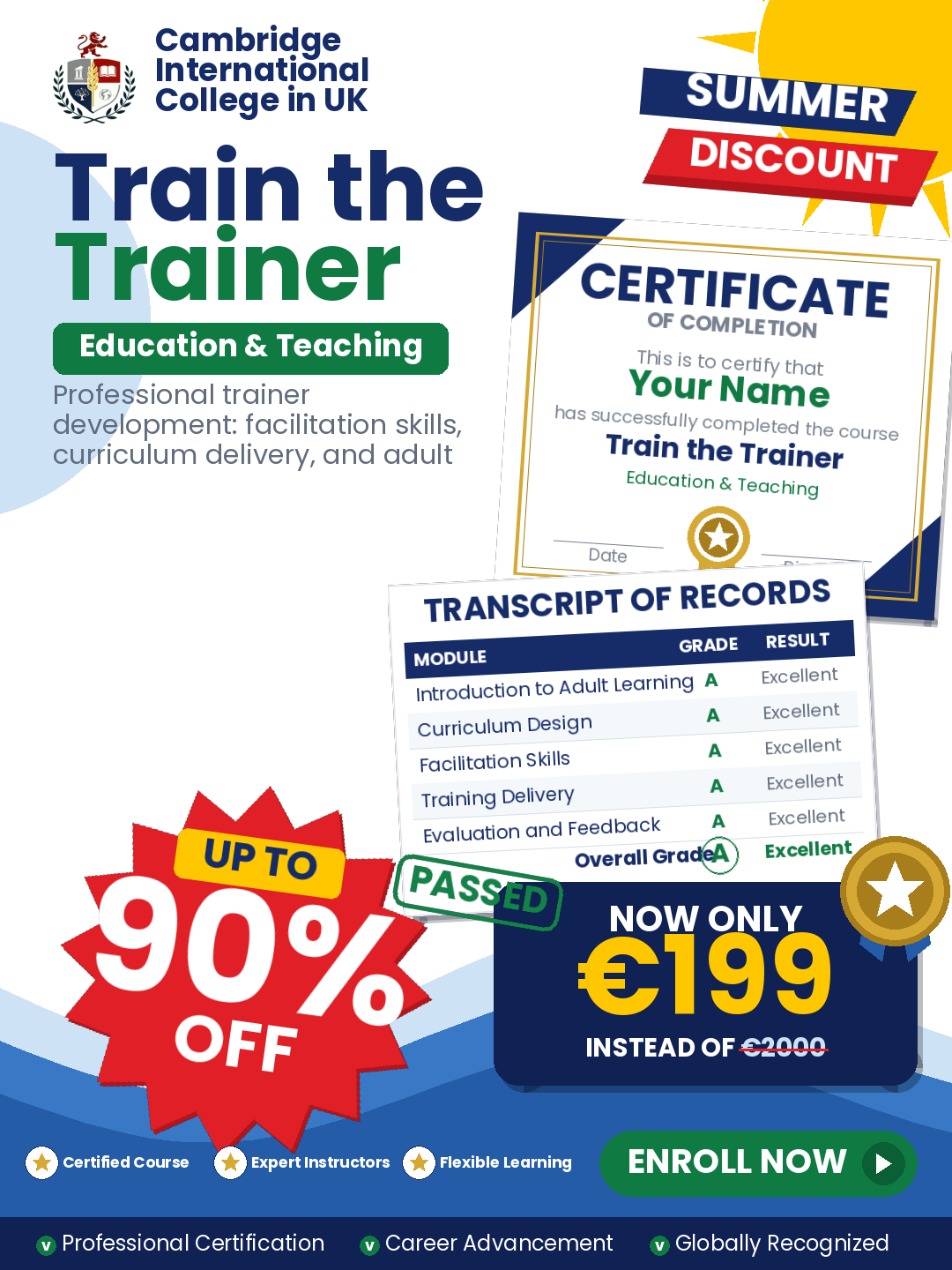
Train the Trainer
Professional trainer development: facilitation skills, curriculum delivery, and adult learning methods.
A closer look at your course
About the Course
The "Train the Trainer" course is designed for professionals who aspire to enhance their training and facilitation skills. This comprehensive program focuses on effective curriculum delivery and adult learning methods, equipping participants with the necessary tools to become proficient trainers. Delivered by Cambridge International College in the UK, this course offers a unique opportunity for professional development through a flexible blended learning approach.
Course Overview
This professional diploma pathway spans 14 months and provides a broader coverage and extended study depth, accumulating a total of 180 credits. The course is structured to accommodate the diverse needs of adult learners, ensuring that all participants can engage with the material at their own pace while benefiting from both online and face-to-face interactions.
Key Learning Outcomes
Upon completion of the "Train the Trainer" course, participants will be able to:
- Develop and deliver engaging training sessions tailored to adult learners.
- Utilize various facilitation techniques to enhance participant engagement.
- Design effective curricula that align with learning objectives.
- Assess and evaluate training effectiveness to ensure continuous improvement.
- Adapt training approaches to accommodate different learning styles and needs.
Who Should Enroll?
This course is ideal for individuals in various sectors who are responsible for training and development within their organizations. Potential participants include:
- Corporate trainers and facilitators
- HR professionals
- Educational instructors and lecturers
- Team leaders and managers
- Consultants and coaches
Course Structure
The "Train the Trainer" course is divided into several modules, each focusing on different aspects of training and facilitation. The blended learning format combines online coursework with in-person workshops, allowing for a rich learning experience. Key modules include:
- Introduction to Adult Learning: Understanding the principles of adult learning and how they differ from traditional educational methods.
- Curriculum Design: Techniques for creating effective training materials and curricula that meet the needs of diverse learners.
- Facilitation Skills: Developing skills to lead discussions, manage group dynamics, and encourage participation.
- Assessment and Evaluation: Methods for evaluating training effectiveness and measuring learner outcomes.
- Practical Application: Opportunities to practice and refine training techniques through real-world scenarios.
Career Opportunities
Completing the "Train the Trainer" course opens up numerous career paths in various fields. Graduates may pursue roles such as:
- Corporate Trainer
- Learning and Development Specialist
- Instructional Designer
- Training Consultant
- Workshop Facilitator
Why Choose This Course?
Choosing the "Train the Trainer" course at Cambridge International College provides several advantages:
- Flexible Learning: The blended learning format allows you to balance your studies with work and personal commitments.
- Expert Instructors: Learn from experienced trainers who bring real-world knowledge and insights into the classroom.
- Networking Opportunities: Connect with fellow professionals and expand your professional network.
- Recognized Qualification: A professional diploma from a reputable institution enhances your credentials and career prospects.
Enrollment Process
To enroll in the "Train the Trainer" course, please follow these steps:
- Visit the Cambridge International College website.
- Complete the online application form.
- Submit your CV and any required documentation.
- Await confirmation of your enrollment.
Conclusion
The "Train the Trainer" course is an invaluable opportunity for professionals looking to advance their training skills and career. With a focus on practical application and adult learning principles, participants will leave the course equipped to make a significant impact in their organizations. Join us at Cambridge International College and take the next step in your professional development journey.
What you’ll learn
Learning objectives drawn from the published course content.
- Separate a performance observation from an assumed training need.
- Identify information that distinguishes knowledge and workplace barriers.
- Define an accountable training enquiry.
- Write an observable learner objective.
- Align assessment with the intended performance.
- Distinguish an administrative activity from evidence of learning.
Show all 54 learning objectives
- Build a feasible session sequence.
- Connect explanation, practice and checking to component needs.
- Account for time without silently removing essential learner work.
- Audit the accuracy of participant materials.
- Preserve access without supplying assessed decisions.
- Distinguish scenario information from real operational authority.
- Make a model's reasoning visible.
- Use a contrasting case to expose a decision boundary.
- Reduce supplied content before inspecting independent performance.
- Link feedback to a specific performance component.
- Preserve useful learner work while correcting a gap.
- Plan revision and a later independent check.
- Create participation routes connected to the learning goal.
- Respond to uneven contribution without stereotyping adults.
- Preserve individual evidence within collaborative activity.
- Construct an unfamiliar aligned assessment.
- Apply a criterion consistently and record assistance.
- Distinguish a local performance result from wider workplace competence.
- Reconcile planned and actual session time.
- Distinguish delivery gaps from evidence of learning failure.
- Plan a recovery with real resources and transparent status.
- Reconcile paired performance counts.
- Calculate clearly named changes.
- Separate descriptive learning evidence from causal and attendance claims.
- Distinguish course performance from workplace application.
- Identify environmental supports and barriers.
- Design a bounded follow-up with realistic ownership and information use.
- Distinguish a training commission from an operational approval.
- Define responsibilities and acceptance evidence.
- Preserve uncertainty when stakeholders want a stronger claim than the records support.
- Preserve the learning function when delivery mode changes.
- Identify access and evidence dependencies.
- Plan a feasible alternative without claiming untested equivalence.
- Identify assessor differences that change the meaning of a result.
- Use annotated responses to moderate a criterion.
- Preserve score history and comparability limits.
- Specify a focused trainer-performance task.
- Reconcile observation and feedback time.
- Distinguish rehearsal success from sustained delivery competence.
- Build a scoped cost statement.
- Distinguish affordable delivery from evidenced benefit.
- Compare options with explicit assumptions and unresolved value questions.
- Define a quality-review criterion and sample.
- Distinguish document presence from learning effectiveness.
- Preserve findings and revision history when evidence is incomplete.
- Integrate trainer design with programme-level decisions.
- Defend scope,resource and evaluation boundaries.
- Use a transparent practice rubric to revise an accountable recommendation.
Inside the curriculum
Explore the published modules and lessons. Full lesson content is available through your student account, with free enrolment. Learning sequence and administrative access controls still apply.
01Needs,Objectives and Session Design3 lessons
Separate a performance observation from an assumed training need. Write an observable learner objective. Build a feasible session sequence.
- Diagnosing Whether a Performance Gap Needs Training
- Defining a Performance Objective and Its Evidence
- Sequencing a Session Around Learning Rather Than Slide Coverage
02Materials,Modelling and Actionable Feedback3 lessons
Audit the accuracy of participant materials. Make a model's reasoning visible. Link feedback to a specific performance component.
- Creating a Complete and Usable Training Case Pack
- Modelling the Decision Process Without Turning Practice Into Copying
- Giving Feedback That Learners Can Use in a New Attempt
03Facilitation,Assessment and Actual Delivery3 lessons
Create participation routes connected to the learning goal. Construct an unfamiliar aligned assessment. Reconcile planned and actual session time.
- Facilitating Participation Without Mistaking Talk for Learning
- Assessing a New Handover With a Stable Criterion
- Recording Actual Delivery and Recovering Lost Practice
04Learning,Transfer and Programme Governance3 lessons
Reconcile paired performance counts. Distinguish course performance from workplace application. Distinguish a training commission from an operational approval.
- Evaluating Learning Without Confusing Net Change and Individual Gains
- Supporting Workplace Application After the Course
- Governing a Training Commission and Its Decision Boundaries
05Blended Delivery,Assessor Calibration and Trainer Development3 lessons
Preserve the learning function when delivery mode changes. Identify assessor differences that change the meaning of a result. Specify a focused trainer-performance task.
- Redesigning a Learning Route Across Online and Offline Conditions
- Calibrating Assessors Without Hiding a Construct Disagreement
- Using Microteaching to Develop Trainers Within Real Capacity
06Resources,Quality Assurance and Integrated Programme Defence3 lessons
Build a scoped cost statement. Define a quality-review criterion and sample. Integrate trainer design with programme-level decisions.
- Interpreting Training Costs Without Inventing a Return
- Reviewing a Training Portfolio Through Scoped Quality Evidence
- Capstone: Defending a Trainer Development and Programme Governance Dossier
Is this course for you?
Who this is for
Training leads,subject specialists and facilitators governing programmes,assessors and trainer development. Eleven certificate foundations are intentionally reused with seven advanced lessons.
Before you begin
Professional reading and basic percentages;all required fictional training cases,procedure cards,templates and keys are supplied.
Who this is not for
Not external trainer accreditation,regulated occupational competence,clinical training,legal advice or authority to change real organisational procedures.
Assessment & completion
20 scenario questions, 5 marks each (100 total), covering every lesson. Complete required lessons and select every correct answer before submission. Portfolio/capstone activities support self or instructor review; the portal does not collect or automatically grade projects and they are not an additional certificate gate. Credit allocation awaits institutional approval.
Materials & resources
6 modules with 18 complete lessons, reviewed sources, a connected fictional case, practice portfolio, scored capstone rubric and reusable template.
Your questions, answered
What is the format of the course?
The course is delivered through a blended learning approach, combining online modules with live sessions.
Is there a final exam?
No, assessment is based on projects and practical applications throughout the course.
Can I take this course part-time?
Yes, the course is designed to be flexible, allowing participants to manage their own pace.
What resources will I need?
You will need a computer with internet access and basic software for completing assignments.
Cancellation policy
Participants may cancel their enrollment up to two weeks before the course start date for a full refund. Cancellations made after this period will incur a 50% fee.
Course inquiry
Send a message about Train the Trainer. Our team will reply by email or phone.